Comprehensive Guarante To Meet Your Diverse Needs
High-definition printing: bright colors and clear patterns
High-quality and durable: wear-resistant and stretch-resistant


High-definition printing: bright colors and clear patterns
High-quality and durable: wear-resistant and stretch-resistant
2026-09-04 08:41:06
Self-Adhesive Labels are widely used for product identification, packaging, logistics, branding, and industrial applications. Unlike traditional labels that require additional glue or mechanical fastening, Self-Adhesive Labels have a pressure-sensitive adhesive layer that allows them to stick directly to a surface when pressure is applied. Their simple application, flexible material options, and ability to support high-quality printing make them suitable for products ranging from food and beverages to electronics, cosmetics, chemicals, and industrial equipment.
However, self-Adhesive labels are not a single type of labeling material. They can be manufactured with different face materials, adhesive types, release liners, printing technologies, and surface finishes. These combinations determine how a label performs in different environments. Understanding the different types of self-adhesive labels is therefore important when selecting a label for a particular product or application.
A self-adhesive label is a multilayer labeling material consisting mainly of a face stock, pressure-sensitive adhesive, and release liner. The face stock is the printable material that carries information such as product names, barcodes, logos, instructions, or regulatory information. The adhesive provides bonding between the label and the target surface, while the release liner protects the adhesive before application.
Most self-adhesive labels use pressure-sensitive adhesive (PSA). The adhesive does not normally require heat, water, or solvent activation. When the label is pressed against a suitable surface, the adhesive makes intimate contact with the substrate and develops adhesion.
Self-adhesive labels can be classified according to their face material, adhesive system, application, or printing requirements. The most common types include paper self-adhesive labels, film labels, removable labels, permanent labels, thermal labels, transparent labels, and specialty industrial labels.
Paper labels are one of the most widely used types of self-adhesive labels. They are economical, easy to print, and available in coated, uncoated, semi-gloss, and textured finishes.
They are commonly used for product labels, shipping labels, barcode labels, food packaging, retail packaging, and promotional labels. Paper provides excellent printability for technologies such as flexographic printing, offset printing, digital printing, and thermal transfer printing.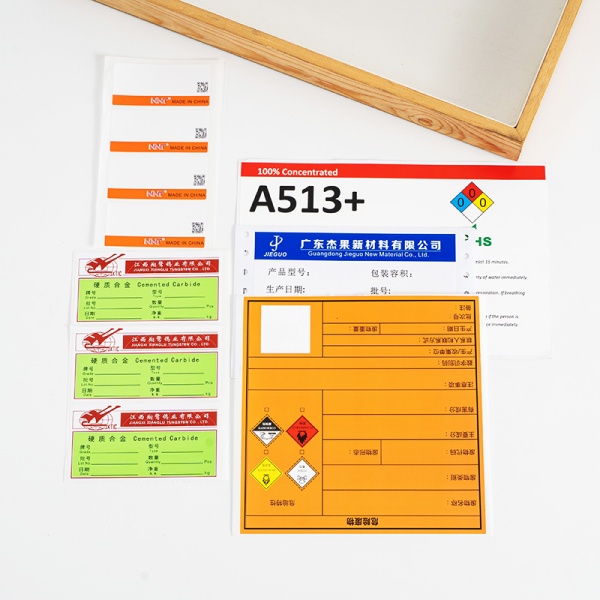
The main advantage is cost efficiency and good print quality. However, standard paper labels have limited resistance to moisture, abrasion, chemicals, and outdoor exposure compared with synthetic film labels.
Film labels are manufactured using synthetic face materials such as PP (polypropylene), PE (polyethylene), PET (polyester), and PVC. They are generally selected when labels need improved durability and resistance to water, chemicals, temperature changes, or abrasion.
PP labels offer good flexibility, moisture resistance, and printability, making them suitable for packaging and consumer products. PE labels are more flexible and can conform to squeezable containers and curved surfaces. PET labels provide excellent dimensional stability, strength, and temperature resistance, making them suitable for industrial and electronic applications.
Compared with paper labels, film labels normally have a higher material cost, but they can provide better performance in demanding environments.
Permanent labels use an adhesive designed to provide strong and long-lasting bonding. Once properly applied, removing the label may cause the face material to tear or leave adhesive residue on the substrate.
These labels are frequently used for product identification, asset labels, warning labels, packaging, equipment labels, and barcode labels where the label is expected to remain attached throughout the product's service life.
Removable labels use a pressure-sensitive adhesive formulated for temporary applications. They are designed to provide sufficient adhesion during use while allowing the label to be removed with less residue or surface damage.
Typical applications include price tags, promotional labels, temporary identification labels, retail displays, reusable containers, and temporary product markings.
Removability depends on several factors, including adhesive formulation, application time, temperature, surface energy, and substrate condition. Therefore, a removable label does not necessarily perform the same way on every surface.
Thermal labels are commonly used for barcode printing, logistics, warehousing, retail, and shipping. Direct thermal labels contain a heat-sensitive coating that reacts to the printhead without requiring ink or a thermal transfer ribbon.
Thermal transfer labels, on the other hand, use a heated ribbon to transfer ink onto the label surface. They generally provide better resistance to heat, chemicals, moisture, and abrasion than standard direct thermal labels.
The choice between direct thermal and thermal transfer depends on the required print durability and operating environment.
Transparent labels use clear film as the face material and are often used when a "no-label" appearance is required. They are popular for cosmetic packaging, beverage bottles, glass containers, premium packaging, and product branding.
Clear PP and PET are commonly used because they provide good transparency and dimensional stability. Printing can be performed with white ink and other specialized processes to improve visual contrast on transparent substrates.
The working principle of a self-adhesive label is based primarily on pressure-sensitive adhesion. When the label is pressed against a substrate, the adhesive layer flows and makes close contact with microscopic irregularities on the surface.
Adhesion is affected by several factors, including surface energy, adhesive tack, peel strength, shear strength, temperature, application pressure, and surface cleanliness. High-energy surfaces such as glass and many metals are generally easier for pressure-sensitive adhesives to wet, while low-surface-energy plastics such as certain polyethylene and polypropylene surfaces may require specially formulated adhesives.
The release liner prevents the adhesive from sticking to the backing material before application. When the label is peeled from the liner, the adhesive becomes exposed and can be applied to the target substrate.
The three basic components of a self-adhesive label are the face stock, adhesive, and release liner.
Face stock: Paper, PP, PE, PET, PVC, and other specialty films.
Adhesive: Acrylic, rubber-based, hot-melt, permanent, removable, or repositionable pressure-sensitive adhesive systems.
Release liner: Typically glassine paper, kraft paper, or polyester film with a silicone release coating.
Different material combinations can significantly change the label's performance. For example, a PET face stock combined with a permanent acrylic adhesive may be suitable for durable industrial identification, while a paper face stock with a removable adhesive may be more appropriate for temporary retail labeling.
The manufacturing process generally begins with the preparation of the face material, adhesive, and release liner. Depending on the label construction, the adhesive is coated onto the face stock or release liner using a controlled coating process.
The adhesive-coated material is then laminated with the other layers to form a self-adhesive label stock. The material may undergo printing, drying, curing, laminating, die cutting, slitting, and rewinding according to the final product requirements.
For custom labels, manufacturers may use flexographic printing, digital printing, offset printing, screen printing, hot stamping, UV printing, and thermal transfer printing. Die cutting is used to create specific label shapes, while slitting and rewinding convert the finished material into rolls suitable for automatic labeling equipment.
Quality control can include checks for adhesive performance, print quality, dimensional accuracy, die-cutting precision, color consistency, and resistance to environmental conditions.
Self-adhesive labels offer several advantages. They are easy to apply, require no separate glue during application, support high-speed automated labeling, and can be customized in many shapes, sizes, colors, and materials. They also provide excellent flexibility for product identification and brand communication.
However, self-adhesive labels also have limitations. Adhesive performance can be affected by temperature, humidity, surface contamination, surface energy, UV exposure, and application conditions. Some adhesives may leave residue when removed, while standard paper labels may have limited moisture resistance. Selecting an unsuitable adhesive or face material can therefore result in lifting edges, poor bonding, label wrinkling, or premature label failure.
Self-adhesive labels are used across many industries because the label construction can be customized according to the application.
Food and beverage: Product labels, ingredient information, nutrition information, and packaging labels.
Cosmetics: Bottle labels, jar labels, branding labels, and transparent labels.
Logistics: Shipping labels, barcode labels, tracking labels, and warehouse identification labels.
Electronics: Product identification, serial number labels, rating labels, and asset labels.
Automotive: Component identification, warning labels, specification labels, and durable industrial labels.
Industrial manufacturing: Equipment labels, inventory labels, instruction labels, and asset identification.
Retail: Price labels, promotional labels, product information labels, and packaging stickers.
The correct self-adhesive label should be selected according to the substrate, application environment, required service life, printing method, adhesive strength, and appearance.
For short-term indoor applications, paper labels with standard adhesive may be sufficient. For applications exposed to water, chemicals, abrasion, or outdoor conditions, synthetic film labels such as PP or PET with a suitable permanent adhesive may provide better performance.
The substrate should also be considered carefully. Labels applied to glass, metal, cardboard, PE, PP, painted surfaces, or textured materials may require different adhesive formulations. For automated production lines, the label's roll configuration, release liner, die-cutting tolerance, and compatibility with the labeling machine are also important.
There are many different types of self-adhesive labels, and no single label construction is suitable for every application. Paper labels are widely used because of their cost efficiency and printability, while film labels provide improved durability and resistance to demanding environments. Permanent, removable, thermal, and transparent labels are designed to meet different functional and visual requirements.
Understanding the relationship between face material, pressure-sensitive adhesive, release liner, printing technology, and application environment makes it easier to select the right label construction. For businesses looking for customized self-adhesive labels, working with a manufacturer that can provide different materials, adhesive options, printing processes, and converting capabilities can help ensure that the finished labels meet the specific requirements of the product and application.
2/F, No. 23, Um Yuan Xin Road, Wentang Community, Dongcheng Street, Dongguan City, Guangdong Province, China
+86 137-1733-9986 +86-0769-22299566


